
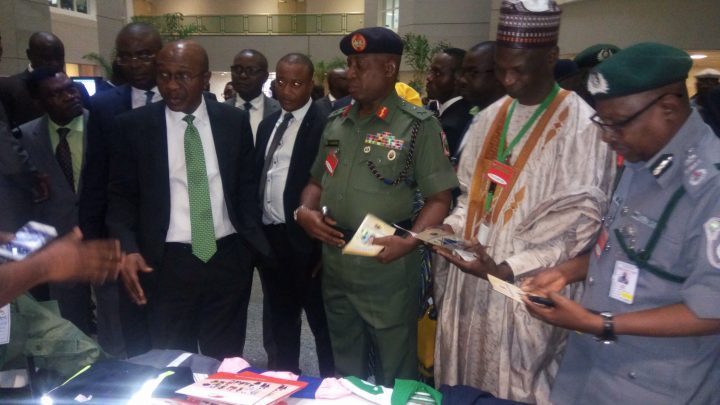
President Muhammadu Buhari has directed all uniform services and hospitals to patronise Nigerian Cotton, Textile and Garment, CTG, industries to grow the economy.
Governor of Central Bank of Nigeria, Godwin Emefiele, said this at a meeting with the Service Chiefs and stakeholders from the CTG sector in Abuja, saying for the present administration to tackle unemployment and grow the economy, the CTG sector must be revived.
Emefiele said the Bank had the mandate of the President to ensure all the uniform services and theatre wears in hospitals and medical facilities are sourced locally from CTG industries, saying already, Bureau of Public Procurement has been notified to enforce compliance among the Ministries, Departments and Agencies of the government.
According to him, their model to achieve this directive or mandate was to facilitate long term contract at least five years or more with these people, saying they wanted to have armed forces and other uniform men to be kitted in wears produced or using local fabrics and textile materials.
He said the CBN was not naive of the fact that the jobs of the uniform men required special and quality materials as well as the security around the wears.
The governor pledged that the team that would be raised by the bank would work with their nominees to ensuring requisite quality and security associated with the uniforms.
Emefiele said the apex bank had started to support the sector from the bottom by funding cotton seeds for the farmers to produce quality cottons.
The representatives of Nigerian Army, Navy, Customs, Immigration, Federal Road Safety Corps, Civil Defence Corps and NYSC, among others, who attended the meeting pledged to support by patronising the industries to boost the economy of the country.
Also, Governor of the Central Bank of Nigeria, Godwin Emefiele, says the Nigerian Cotton, Textile and Garment (CTG) sector holds huge potentials to create more than two million jobs and reduce 4.0 billion dollars import bill incurred annually on textile.
Emefiele said the sector also had the capacity to transform Nigeria’s rural economy and revive the textile and garment industries by improving internal revenue across three tiers of government.
He said by achieving that, it would safeguard and earn foreign exchange and ultimately accelerate industrial development by making Nigeria a global player in the textile and apparel sectors.
“This event, therefore, symbolises our commitment to attain self-sufficiency in cotton production, to serve the Textile and Garment segments of the value chain with quality input, as we target zero importation by the year 2020.
“I am pleased to inform you that I have been holding meetings with the Cotton, Textile and Garment (CTG) sector stakeholders toward reviving Nigeria’s textile sector.
“We analysed the huge potentials that exist in the sector, identified the challenges militating against the sector’s contribution to Nigeria’s growth and development and presented quick wins for reviving the sector.
“The CTG sector is however faced with some systemic challenges which has hampered and diminished its role as the leading employer of labour, thereby preventing its contribution to Nigeria’s GDP.
“In the 1970’s and early 1980’s, Nigeria was home to Africa’s largest textile industry, with over 180 textile mills in operation, which employed close to over 450,000 people and contributing over 25 per cent of the workforce in the manufacturing sector.
“Today, most of the factories have all stopped operations, as only 25 textile factories are operating today at below 20 per cent of their production capacities, and the workforce in Nigeria’s textile industry stands at less than 20,000 people,” he said.
The Central Bank Governor disclosed that their interaction with stakeholders revealed that MDAs had not made any significant order for uniforms or clothing materials from Nigerian textile manufacturers and garment companies.
He added that governments’ efforts at resuscitating the textile industry would not be actualised if they were not supported through local patronage among other incentives.
“As a first step, we flagged-off the 2019 Wet Season Cotton Input Distribution to 150,000 farmers in Katsina, Katsina State on May 6th, 2019 under the Anchor Borrowers’ Programme.
“These are cultivating over 180,000 hectares of cotton that will feed our ginneries and be used in the production of high quality textile for use by the armed forces and other uniformed service organisations.
“Production is also ongoing across 23 states of Nigeria with more to come onboard in the next planting season. We have also put in place necessary mechanisms to ensure use of high yielding varieties that will produce top quality fabrics and those that can compete in the international market” he added.
He said the bank observed that the local textile factories were carrying huge quantities of unsold stock while garment factories were idle due to lack of local patronage.
Emefiele expressed optimism that with the support and cooperation of the uniform organisations, this trend could be reversed.

