
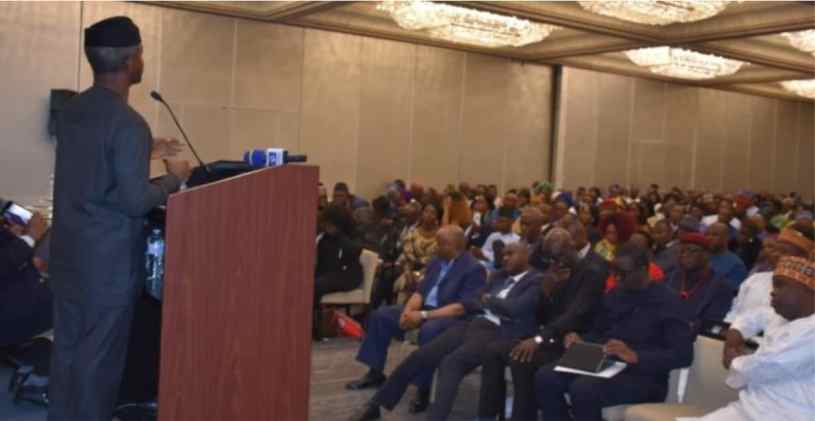
Vice President, Yemi Osinbajo, says the Federal Government is committed to the rescue of Leah Sharibu, one of the schoolgirls abducted Boko Haram in Dapchi, Yobe State.
Osinbajo stressed that over 108 girls have been rescued so far, and added that community policing can effectively tackle the nation’s security challenges including kidnappings.
“There are cases that are as important as other cases that have received worldwide attention. But at the same time, when you measure it against the performance of girls that have been freed till date, over 108 Christian girls.
“We shouldn’t say it’s Christian religious freedom, but who is responsible for kidnapping is committing an economic crime. To solve the problem, we need community, we need the state police,” he said.
Osinbajo also reacted to questions asked by diaspora Nigerians on poverty and unemployment in the country.
He lamented that the country recorded a population of 112.7 million people living in extreme poverty in 2010.
He claimed that the government during that period did not create Social Investment Programmes that will help ameliorate the situation.
“As at 2010, Nigeria had about 112.7million people living in extreme poverty. Nothing in place, there was no Social Investment Programme, there was no social security, no way of taking people out of poverty.
“That was the reason why we decided to put in place the National Social Investment Programme because it was to address questions of how to get our people out of poverty,” Osinbajo said.
Osinbajo has urged Nigerians in the Diaspora not to rely entirely on social media reports on the security challenges facing the country.
Many members of the audience had taken turns to express concern about the reported spate of killings and kidnapping back home, and wanted to know what the government is doing to address the situation.
“With respect to general kidnapping which we have seen in parts of the country, again, this is not entirely new.
“In fact, some of the kidnapping stories you read or listen to are simply not true anywhere, some are fuelled by politics.
“There are cases of kidnapping, no question at all about that, but some of the more dramatic stories that you hear are simply not true.
“Every report of kidnapping we receive, we try to verify, and at the end of the day you find out that people just tell all sorts of stories,” he said.
The vice president said the Federal Government was working with the states to check kidnapping where it was actually taking place, using technology to track the perpetrators.
He said the efforts were already yielding results with several arrests made by security agencies in affected areas.
Osinbajo said the government was capable of addressing the security challenges, assuring Nigerians that the news “will be a lot better very soon”.
Turning to banditry and farmers/herders clashes in the north west and central, the vice president described them as “resource conflicts”.
According to him, banditry especially in Zamfara and Katsina was more of a fight over the control of mining sites by armed groups.
He said the government was taking several measures, including shutting down the mines, to address the problem.
“In the north central, we have the livestock transformation plan to address the farmers/herders conflict.
“Ultimately, it is ranching that will solve the problem because you cannot have people wandering across the the country with their cattle.
“It is not helpful to them, this they know, because ranching is more convenient and profitable.
“So, we are building herd dams in the northern states so that people don’t necessarily come down south in search for water and green pastures for their herds.
“We are also trying to ensure we provide grazing areas before we come to cattle routes,” he added.
Osinbajo said in fairness to herders, the livestock sector had not enjoyed the kind of government’s funding and support accorded farmers over the years.
He stated that there was also need for government’s intervention in livestock, and solicited private sector support and investment in that area.
Osinbajo has told Nigerians in the Diaspora that the spate of kidnappings in Nigeria is exaggerated and not entirely new.
This is despite recent travel advisories issued by the United States and the United Kingdom asking its citizens not to visit some states in Nigeria due to the rising insecurity occasioned by kidnapping, banditry, militancy, terrorism and other challenges.
The Vice-President spoke in response to several questions and comments on the security situation back home.
Many members of the audience had taken turns to express concern about the reported spate of killings and kidnapping back home, and wanted to know what the government is doing to address the situation.
He said, “With respect to general kidnapping which we have seen in parts of the country, again, this is not entirely new. In fact, some of the kidnapping stories you read or listen to are simply not true anywhere, some are fuelled by politics.
“There are cases of kidnapping, no question at all about that, but some of the more dramatic stories that you hear are simply not true.
“Every report of kidnapping we receive, we try to verify, and at the end of the day you find out that people just tell all sorts of stories.
Osinbajo said the Federal Government was working with the states to check kidnapping where it was actually taking place, using technology to track the perpetrators.
He said the efforts were already yielding results with several arrests made by security agencies in affected areas.
Osinbajo said the government was capable of addressing the security challenges, assuring Nigerians that the news “will be a lot better very soon”.
Turning to banditry and farmers/herders clashes in the North-west and central, the Vice President described them as “resource conflicts”.
According to him, banditry, especially in Zamfara and Katsina, was more of a fight over the control of mining sites by armed groups.
He said the government was taking several measures, including shutting down the mines, to address the problem.
The Vie-President added, “In the North Central, we have the livestock transformation plan to address the farmers/herders conflict.
“Ultimately, it is ranching that will solve the problem because you cannot have people wandering across the country with their cattle.
“It is not helpful to them, this they know, because ranching is more convenient and profitable.
“So, we are building herd dams in the northern states so that people don’t necessarily come down south in search for water and green pastures for their herds.
“We are also trying to ensure we provide grazing areas before we come to cattle routes.”
Osinbajo said in fairness to herders, the livestock sector had not enjoyed the kind of government’s funding and support accorded farmers over the years
 securityandsafetymatters