
There is need for national and regional collaboration to tackle the security challenges being confronted in the maritime domain of the Gulf of Guinea.
Also, there is need for an appraisal of multinational approaches to enhance maritime security in the Gulf.
President Muhammadu Buhari made the call in Lagos while declaring open a two-day conference organised by the Nigerian Navy to mark its sixty-second anniversary, attended by navies of Gulf of Guinea states and friendly navies around the world, including Pakistan, China, Brazil and Portugal.
Buhari, however, acknowledged that the Gulf of Guinea States had long recognized that Security in the Gulf was both a challenge to maritime safety and a significant threat to their economic prosperity.
According to him, the Gulf of Guinea is perhaps one of the most strategic maritime geographies in the world, saying on account of its proximity to the European and North American markets, the Gulf of Guinea has been an important route for container ships headed for Europe and America.
Besides, Buhari said the Gulf hosts one of the most important regions for oil and gas production and transportation, saying it also contains some of the largest hydrocarbon deposits ever discovered.
He said but in the past few years the Gulf had experienced security challenges that have made it one of the most problematic maritime spaces in the world, recalling that in twenty-sixteen, the International Maritime Bureau recorded fifty-three piracy attacks or attempted attacks in the Gulf of Guinea representing twenty-eight per cent of worldwide attacks.
Quoting further from the report, he said the Gulf also accounted for more than fifty per cent of the global kidnappings for ransom, with thirty-four seafarers kidnapped out of a total of sixty-two worldwide.
“Besides, the trafficking of arms, drugs and persons, widespread unregulated and unreported fishing activities, severe environmental damage and pollution have remained constant challenges.”
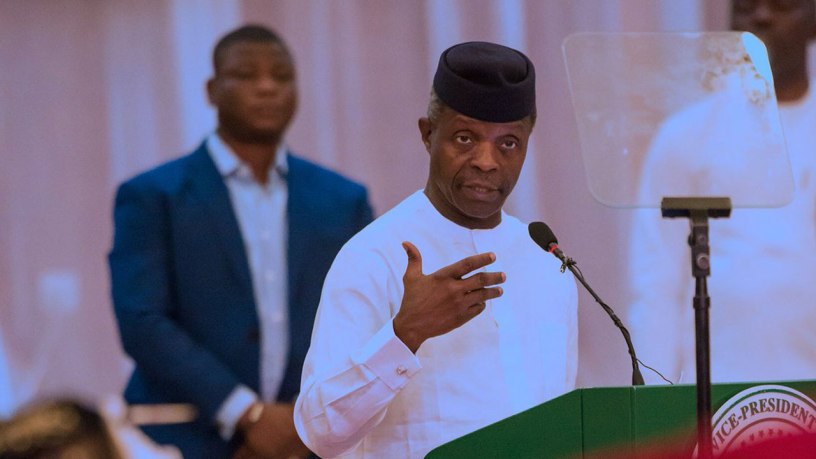
The president who spoke through his Vice, Yemi Osinbajo said the establishment of the Gulf of Guinea Commission in twenty-zero-one and other measures taken by individual and member states were important initiative aimed at combating threats in the gulf.
Piracy in the Gulf of Guinea affects a number of countries in West Africa as well as the wider international community.
By 2011, the UN said it had become an issue of global concern.
Pirates in the Gulf of Guinea are often part of heavily armed criminal enterprises, who employ violent methods to steal oil cargo.
In 2012, the International Maritime Bureau, Oceans Beyond Piracy and the Maritime Piracy Humanitarian Response Programme reported that the number of vessels attacks by West African pirates had reached a world high, with 966 seafarers attacked during the year.
As of 2014, pirate attacks in West Africa mainly occur in territorial waters, terminals and harbours rather than in the high seas.
This incident pattern has hindered intervention by international naval forces.
Pirates in the region operate a well-funded criminal industry, which includes established supply networks.
They are often part of heavily armed and sophisticated criminal enterprises, who increasingly use motherships to launch their attacks.
By 2010, 45 and by 2011 64 incidents were reported to the UN International Maritime Organization.
However, many events go unreported.
Piracy acts interfere with the legitimate trading interests of the affected countries that include Benin, Togo, Côte d’Ivoire, Ghana, Nigeria, and the Democratic Republic of Congo.
By 2017 it became apparent that the problem of kidnapping had been increasing with 96 seafarers taken hostage that year versus 44 in the year prior.
In his remark, the Chief of Naval Staff, Vice Admiral Ibok Ibas, said maritime crimes and threats in the Gulf of Guinea called for serious concern as it affected economic lifeline of member states, saying the maritime threats had become transnational and have gone beyond the capability of one nation to contain.
He said the conference would provide a platform to collectively offer the way forward that would address the myriads of challenges and enhance maritime policing.
In his address, Governor Akinwunmi Ambode of Lagos State, said international waterways were the main corridor through which commerce had nurtured relations among countries, saying sea piracy accounted for 30 per cent of attacks in African regional waters between 2003 and 2011, affecting commercial shipping and trade activities of countries.
Ambode who spoke through his Deputy, Idiat Adebule said the economic benefits which abound in maritime trade for African nations and investors could only be fully realised with the safety and security of the offshore boundaries, saying unless they collectively tackle the challenges, it would continue to affect the fortunes of merchant vessels and fishing tourists negatively, with consequent impact on commerce and trade development for countries in Africa and around the world.
Also speaking, Governor Emmanuel Udom of Akwa Ibom, commended the Navy for doing a lot to check the activities of pirates in the coastal areas, especially in Akwa Ibom, saying their administration would continue to support and ensure strong partnership with the Navy in their quest to combat maritime crimes and ensure safety on our coastal areas.
He said the state would donate two Gulf Boats to the Navy to enhance its sea patrol in keeping the waters safe.
The conference, with the theme ‘Enhancing Collaboration for Effective Maritime Security in the Gulf of Guinea’, attracted military service chiefs, security experts, captains of industry and members of the diplomatic corps.

