
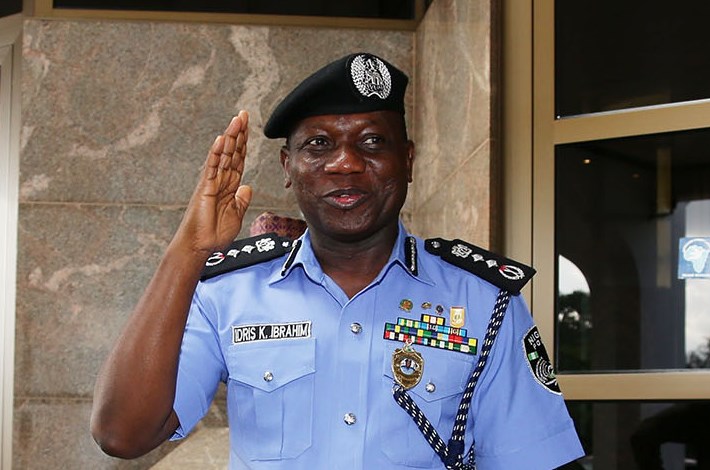
The respect for the rights of people by the police in the discharge of their duties, is the only way to achieve true security, peace and reconciliation in the criminal justice system.
This, according to the Inspector-General of Police, Ibrahim Idris, could only be achieved when the police was continually trained and retrained on the need to uphold the rights of the citizens.
Idris said this was to ensure the Police, while performing their constitutional duties of protection of lives and property, do so within the confines of the law.
On Benue Crisis, Idris said the Police had moved in to resolve the crisis in Benue State, by dialoguing with the herdsmen and farmers, with a view to restoring peace in the state, saying he was personally in the state to have a meeting with the parties involved, saying the responses has, so far, been encouraging.
Aside the reconciliation moves, he said the Police Command has established 15 units in the state to stem any likely outrage, adding that he is personally monitoring the progress there.
The IGP said: “The challenges we are having with these herdsmen have gone down. In Benue, we have 15 Police units on ground and I have been monitoring their successes. I was in Benue and we have been having stakeholders’ meetings, we have been discussing.
“Based on this, people have been coming openly to state their problems and it is through these means that we can understand each other and reconcile our differences. “The role of traditional rulers in this reconciliation process cannot be over emphasised because most of them have the ears of their people. When you have political disagreement in these communities, these traditional rulers are handy.
On Twenty-nineteen election, Idris said the police was ready for the elections, which would hold in February and March.
He said: “We are prepared for the elections. We have the men and we have the materials (logistics) to carry out our duties successfully before, during and after the elections.”
The Inspector-General of Police spoke in Lagos at the public presentation of his book: Security and justice: The pathway for peace and reconciliation in Nigeria.
The 292-page book has eighteen chapters and proffers solutions to violence, corruption and other society menace.
The police chief said there was need for justice and reconciliation to ensure meaningful development, said the country’s security challenges would be contained if Nigerians pursued true reconciliation and shunned inflammatory comments.
“The role of traditional rulers in this reconciliation process cannot be over-emphasised because most of them have the ears of their people. When you have political disagreement in these communities, these traditional rulers are handy.”
The Police Chief said this at the Public Presentation/Launching of the book titled “Security and Justice the Pathway for peace and Reconciliation in Nigeria”.
Dedicating his book to his men, Idris said proceeds from its sale would be used to fund the Security and Justice Initiative, a foundation being established for the promotion of peace, security and reconciliation in Nigeria.
He explained that the reason for writing the book was in recognition of the Nigeria Police as the nation’s core law enforcement agency which is constitutionally saddled with the responsibility of preventing and detecting crime, apprehension and prosecution of offenders, preservation of law and order.
In addition, he said: “I have watched with troubled heart the security challenges confronting this country.
The challenges of Boko Haram in the North East, the challenges of kidnappings and armed robberies, cattle rustling and militancy in virtually all parts of Nigeria.
“The farmers/herders clashes, the challenges of assassination for various reasons, the challenges of conflicts among the divergent communities which often times take dangerous dimensions and occur along the fault lines of ethnic, religious, regional and political differences between the divergent groups and communities.
“These challenges if not properly managed at the pace we are going, coupled with inflammatory and inciting statements ,will tear this country apart and drag us into an unending crisis. “As the IGP, it is my responsibility to put sufficient security architecture in place to manage the challenges aforementioned.
I can say with confidence that the emplaced preventive and detective strategies have been largely successful in managing the situation based on my achievement so far.”
In attendance were Secretary to Lagos State Government Tunji Bello, Oba of Lagos Rilwanu Akiolu, former Minister of State Defence Musiliu Obanikoro, former Ogun State Governor Olusegun Osoba, Chairman Police Service Commission Mike Okiro, former IG Sunday Ehindero, former head of Lagos State Security Trust Fund, Aderemi Makanjuola, consulars and high commissioners/ambassadors of about twenty countries. There were also heads of military and paramilitary services.
In his remark, Oba Rilwan Akiolu of Lagos attributed the infiltration of strangers, who hide under the cover of herdsmen to carry out orgy of killings in the country, to the porosity of the borders.
Oba Akiolu praised the police chief for the book and blamed the porous borders and unattended forests for the lingering herders/farmers clashes in some parts of the country.
While he called on the federal government to make adequate fund available to the Police to curb insecurity, he said: “The police will do well if they are given the wherewithal to perform their duties.
The IG has not been given all that is necessary to do his job. The other time, he said he would need N3 trillion to tackle security challenges in the country. That amount is not even enough to address insecurity in Nigeria.”
The monarch announced his second term endorsement for Lagos State Governor Akinwunmi Ambode and warned that anyone who contested against him would fail.
Osoba, an accomplished journalist and former Managing Director of The Daily Times, said the first step to reconciliation was devolution of power, adding that any reconciliation that failed to recognise the need for decentralisation of power would not succeed.
In his welcome address, the Commissioner of Police, Lagos State Police command, Imohimi Edgal stated that the book could not have been written at a better time than now, describing the title as apt and germane to national discourse.
Makanjuola said: “The book could not have come at a better time. You will find a lot of things that are not new but will also find a lot of solutions you never knew. He touched every facet of the country in the book.
“I commend the police because before people are scared to go out at night but now, that has changed as people freely move about.
On his part, former Inspector General of Police, Sunday Ehindero kicked against the idea of State Police, saying Nigeria was not yet matured for it.

