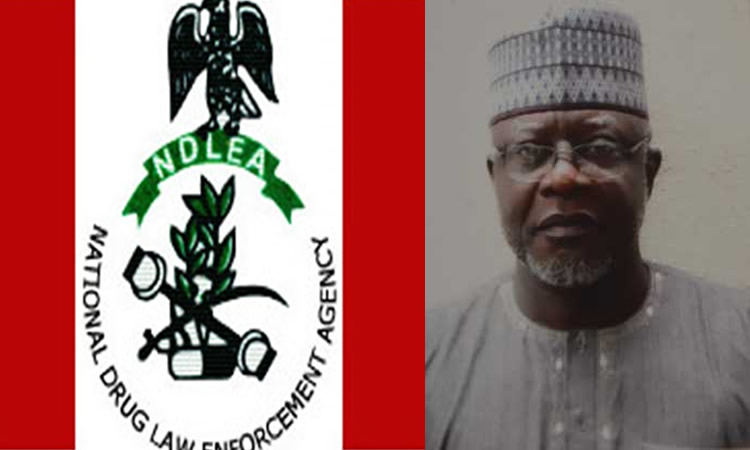
Chairman, Nigerian Drug Law and Enforcement Agency (NDLEA), retired Col. Muhammad Abdallah, on Tuesday said 77,558 persons were arrested for drug trafficking between 2015 and 2016.
Abdallah, who was represented by Kayode Adeniyi, a Commander in the agency, said this in Lagos at a one-day seminar to mark the International Day Against Drug and Human Trafficking.
He said drug trafficking otherwise tagged as the most lucrative business, was usually motivated by the profit which could generate about $320 billion dollars per annum.
The NDLEA first discovered a methamphetamine laboratory at Maza-Maza area of Lagos in 2011 and till date, 12 other laboratories were discovered in Lagos, Anambra and Delta States.
Of the arrested 77,558 drug traffickers, 72,735 are males while 4,823 are females; so you can see that the business of drug trafficking does not have to do with just the male gender.
It is very painful that Nigeria has been implicated as a source, transit and destination point for drugs and human trafficking,” he said.
The chairman called for the collaboration of all security agencies to share information on how to effectively check the menace of drug trafficking.
He also said public enlightenment should be embarked upon to educate people on the evils of drug and human trafficking.
The Chairman of the occasion, Wale Olaoye, Chief Executive Officer, Halogen Security, said human trafficking in the next few years would surpass illegal sale of arms, and this should be taken as important.
The laws governing human and drug trafficking also needs to be made stiffer as fines no longer make the laws effective enough to check the menace.
We need to look deeper on how all security agencies can work together on information,” olaoye said.
He also said that the border control system also needed to be made more effective and robust to counter issues of trafficking.
The Commissioner of Police in Lagos State, Mr Fatai Owoseni, who was represented by ACP Akinbayo Olasuji, said a department of the Nigeria Police at Alagbon often took up cases of child abandonment and illegal adoption.
Owoseni said the adoption system in the country was a flop and needed to be checked.
A representative of the National Agency for Prohibition of Trafficking in Persons (NAPTIP) Director General, Kehinde Akomolafe, said that human trafficking was a modern day slavery which needed to be checked.
It is a crime that cannot be done by just a person but syndicates and also involved money laundering and drug trafficking.
Sometimes, the victims see the traffickers as their benefactor which is a major challenge and NAPTIP has set up nine zonal offices across the six Geo-political zones to check the menace.
Human trafficking is an evil that can be brought to an end through collaboration with a source, transit and destination country,” she said.
She added that NAPTIP had commenced sensitisation as ignorance is often seen as the reasons and excuse.
According to her, the law governing human trafficking had been repealed in 2015 and included stiffer punishments, no options of fine and proceeds of trafficking go into victims trust fund.
Assistant-Controller General, Nigeria Immigration Service, Isyaku Hamad, who was represented by Odutola Fashakin reaffirmed the NIS unalloyed support to the fight against human trafficking.
We organise sensitisation programmes for our officers as they are trained to reject requests for passports by suspected traffickers.
Also surveillance had increased at our 774 offices and we are collaborating with other security agencies and signed MoU with some countries to check the menace of human trafficking,” Hamad said.
ACP Frank Mba, also a guest lecturer at the occasion, said that baby factory was fast becoming another phase of human trafficking.
Baby factory as a form of human trafficking is thriving locally and internationally and it is a major concern.
This is usually as a result of stigmatisation of teenage pregnancy and out of wedlock pregnancy in the society.
We need to check the demand and supply chain and and sensitise people that teenage pregnancy is not a crime against humanity.
The government should also subsidise fertility treatment and streamline adoption in the country,” he said.

