
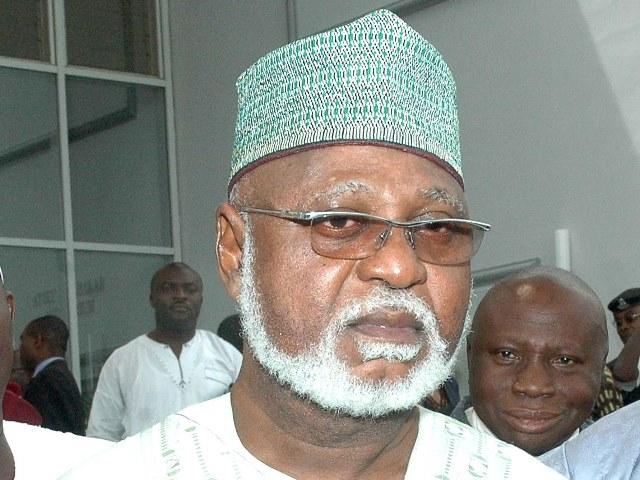
A former Head of State, retired General Abdulsalami Abubakar has expressed satisfaction that the Boko Haram insurgency in the North East “has been substantially degraded.’’
Abubakar, who was the guest speaker at the opening of a three-day regional conference on “Peace Building and Reconstruction in the Chad Basin,’’ however, noted that terrorism was an enemy difficult to defeat.
The conference is co-hosted by the Nigerian Army and the Centre for Peace and Security Studies, Modibbo Adama University of Technology, Yola.
The former head of state lamented that the insurgency had taken unprecedented toll on human, property and ecology of the countries around the Chad basin.
According to him, planning for post-insurgency situation – peace building and reconstruction in the area requires a clear understanding of the cause of the conflict.
Quoting statistics from the UN, he said as at November, 2015 there were over 2.2 million IDPs in Nigeria, over 158, 000 in Cameroon, over 66,000 in Chad and 47, 000 in Niger.
He said during the period, 1.6 million IDPs were in Borno alone, being the epicenter of the insurgency, while 218,000 villages and hamlet were affected by the insurgency, saying infrastructure damaged included 18,000 houses and 22,000 schools.
Still quoting from the UN, Abubakar said the losses recorded due to the conflict during the period among to 5.9 billion dollars or N1.8 trillion.
“This of course, is deepening the state poverty in a region classified among the poorest in sub-Sahara Africa.
“The statistics also show that as at Nov. 2015, three million people are trapped in areas regarded as inaccessible and likely to be killed or become victims of security incidents, human rights violation, physical abuse, extortion, raping and sexual violence, among others.’’
He also quoted from the UNICEF, saying that in Borno alone, 257,000 children under the age of five were likely to suffer from malnutrition in 2016 as a result of the insurgency.
In his remark, the Chief of Army Staff, Lieutenant-General Tukur Buratai noted that there was lack of comprehensive road map and master plan for the rehabilitation of insurgency ravaged region, saying this had resulted in the absence of formidable synergy among the numerous agencies involved.
Buratai said the major challenge was lack of research-based data on the real life challenges confronting the IDPs in the form of comprehensive post conflict need assessment, saying the lack of synergy was affecting effort by government agencies, NGO and the armed forces, as well as international partners in caring for IDPs.

