
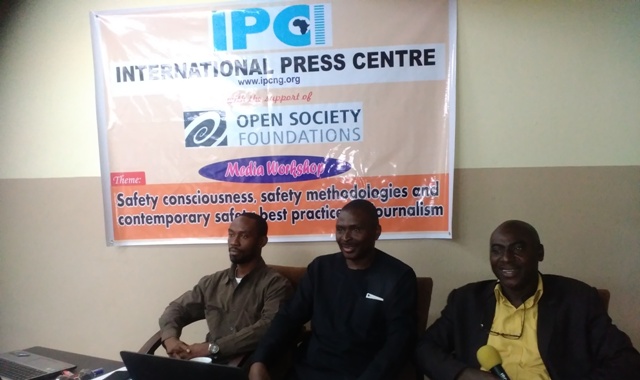
Following the various attacks, intimidate, assault on journalists, the need for journalists to be security and safety conscious has again been stressed by speakers at a two-day media roundtable/tweet conference organised by International Press Centre with support of Open Society Foundations.
Participants were drawn from the media both electronic, print, and social, and civil society.
In a welcome remark, Director of International Press Centre, Lanre Arogundade, said the aim of the confab was to promote safety consciousness among journalists in Nigeria because of growing incidence of attacks on journalists.
Arogundade, a former Chairman of the Lagos State Council of Nigeria Union of Journalists, said the objective was to introduce print, broadcast and online journalists especially investigative, crime, judiciary, business, and conflict reporters to best practices in safety conciousness including advanced techniques in data, information and source protection.
According to him, the overall goal is to facilitate a free and safe environment for journalists and other media professionals in Nigeria.
Arogundade, said it was imperative to ensure higher safety consciousness and engage media and other stakeholders including the enforcement agencies on measures to mitigate incidents of attacks on journalists and the media in Nigeria.
In his presentation on Safety of Journalists in Nigeria, the challenge of an enabling legal environment, Activists Lawyer, Barrister Mohammed Fawehinmi urged advocates of safety for journalists to start looking into laws that were against the practice of journalism.
Also, Fawehinmi, said the constitution says the press, radio, television and other agencies of the mass media shall at all times be free to uphold the fundamental objectives contained in this Chapter and uphold the responsibility and accountability of the Government to the people.
Fawehinmi, son of late Senior Advocate of Nigeria, Senior Advocate of Masses, Chief Gani Fawehinmi, said the safety of journalists should go beyond the role of the government and security agencies, as the employers of journalists also have roles to play, because when journalists were not paid their salaries as at when due, their lives and those of their dependents were at risk.
Speaking on Security for Journalists Reporting In Hostile or Unsafe Environment, Executive Director of International Centre for Investigative Reporting, Dayo Aiyetan, gave some scary information, saying thirty journalists were killed yearly around the world, one hundred and fifty journalists were in jail at any given time, many without charges filed against them, thirty-five journalists in different parts of the world were missing at any time,
Hundreds were threatened, harassed or attacked and many had their phones or email addresses intercepted.
Aiyetan advised that there was need for a reporter to first research his assignment, do proper research before going into hostile environment, as it provides him information about steps needed to be taken that might later save his life.
He said in theory, a news medium had the responsibility to provide reporters basic protection when sending them into hostile or unsafe environments, providing resources, tools, insurance and medicals, giving proper training to reporters about the hostile beat or risky assignment.
On his part, West African Representative of Committee to Protect Journalists, Peter Nkanga, who spoke on International Frameworks, Standards and Issues in the Protection of Journalists said research shows that one hundred journalists were killed between nineteen ninety-two and twenty-eleven while covering violent civil disturbances.
Nkanga said in twenty-eleven alone, all work related fatalities in the industry involved journalists covering such assignments, saying a reporter was at such scene to report the assignment not to report rioters to the police, do not take sides.
Participants enjoined media owners to take safety of their employees very seriously and something of priority, imploring journalists to be security conscious too in carrying out their day-to-day activities.
 securityandsafetymatters