
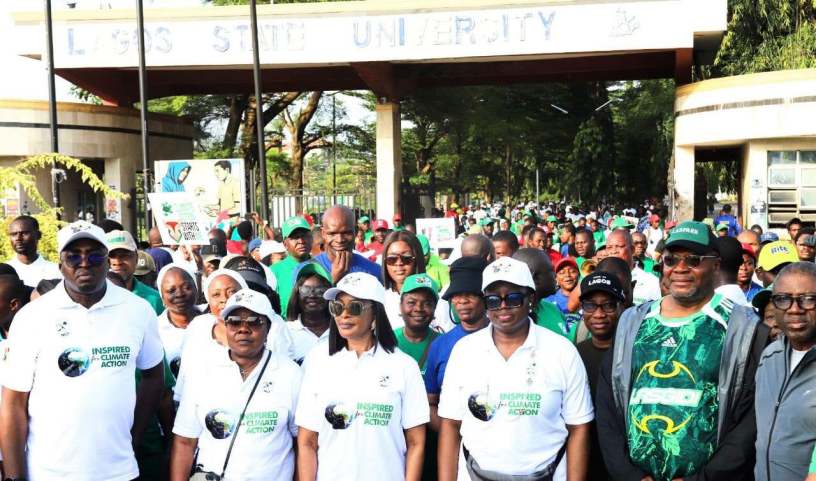
The Lagos State Government and the Nigerian Conservation Foundation, NCF, have intensified calls for urgent climate action, commitment to environmental sustainability and climate resilience.
Both asks residents to take urgent and collective action against plastic pollution and degradation of natural ecosystems.
Governor Babajide Sanwo-Olu made the call at the 20th edition of the annual Walk for Nature, organised by the Lagos State Ministry of the Environment and Water Resources in partnership with the Nigerian Conservation Foundation (NCF), held at Makanjuola Hall, Lagos State University (LASU), Ojo.
The Governor, who spoke through the Permanent Secretary, Office of Environmental Services, Gaji Tajudeen, said the 20th edition provided an opportunity to reflect on the progress made in raising environmental awareness and renew the commitment to translating awareness into measurable environmental action.
Sanwo-Olu noted that Lagos generates approximately 13,000 tonnes of waste daily, with plastics accounting for about 15 per cent.
He expressed concern that improperly disposed plastic waste frequently finds its way into drains, canals and the lagoon, contributing to flooding and environmental pollution.
Sanwo-Olu described the challenge as one with direct implications for public health, homes, businesses and transportation.
He stressed that Lagos, as a coastal state with low-lying and densely populated communities, could not afford to delay action on climate change.
According to him, the state’s wetlands, mangroves and lagoon fronts serve as natural defences against flooding and coastal erosion.
He warned that indiscriminate reclamation and development in these environmentally sensitive areas expose communities to greater risks.
The Governor outlined the government’s interventions in three critical areas: plastic pollution control, the protection of wetlands and the expansion of drainage and green infrastructure.
On plastic pollution, he recalled the state’s ban on Styrofoam and other specified single-use plastics, noting that enforcement commenced on July 1, 2025.
He added that the government was also working with innovators to promote sustainable alternatives while strengthening environmental education in schools and communities.
Speaking on wetland protection, Sanwo-Olu stated that the government suspended reclamation activities on wetlands, floodplains and lagoon fronts without the requisite Environmental Impact Assessment approvals and drainage clearances in September 2025.
He emphasised that all development activities must comply with environmental regulations and drainage requirements, noting that the protection of wetlands and mangroves was essential to building a safer and more climate-resilient Lagos.
The Governor further reaffirmed the administration’s commitment to investing in drainage infrastructure, restoring mangroves, planting trees and developing parks to strengthen the state’s natural defences against flooding and rising temperatures.
Sanwo-Olu stressed that government efforts would achieve greater impact with the active participation of residents.
He urged them to dispose of waste responsibly, keep drains and drainage channels clear, reduce their reliance on single-use plastics and avoid building on wetlands and drainage corridors.
Addressing participants and students of Lagos State University at the exercise, he encouraged them to take the lead in promoting environmental responsibility within their hostels and surrounding communities through waste separation, tree planting and the adoption of sustainable practices.
He also urged young people to hold themselves, their communities and government accountable for protecting the environment.
Sanwo-Olu noted that their generation would bear the long-term consequences of decisions taken today.
The Governor commended the Nigerian Conservation Foundation for sustaining the Walk for Nature over the past two decades and acknowledged the contributions of the Ministry of the Environment and Water Resources, partners, volunteers and participants to the success of the initiative.
Sanwo-Olu urged participants to sustain the spirit of the exercise by making environmentally responsible choices in their daily lives.
He stressed that the success of the initiative would ultimately be measured by actions taken to protect the environment long after the walk has ended.
In his welcome address, the Permanent Secretary, Office of Environmental Services, Gaji Tajudeen, described the 20th edition of the Annual Walk for Nature as a significant milestone in Lagos State’s sustained advocacy for nature conservation, environmental awareness and responsible stewardship of natural resources.
Gaji, who spoke through the Director, Ecology and Wetlands, Tolu Adeyo, noted that the initiative has, over the past two decades, provided a vital platform for Government, conservation organisations, academia, the private sector, communities and young people to promote environmental sustainability.
Highlighting the theme, “Inspired for Climate Action – Lagos Must Listen, Our Action Matters, Tajudeen stressed that climate change was no longer a distant concern, as its impacts were increasingly evident in rising temperatures, changing weather patterns, flooding and biodiversity loss.
He emphasised the importance of protecting and restoring natural ecosystems, particularly wetlands, mangroves, waterways, forests and green spaces, which serve as natural buffers against flooding, support biodiversity, store carbon and sustain community livelihoods.
He called on residents, businesses, communities and institutions to translate environmental awareness into practical action, stressing that climate resilience could not be achieved by Government alone.
Also speaking, the Chairman of the NEC of the NCF, Justice R.I.B Adebiyi, described the climate crisis as a test of man’s responsibility, his creativity, courage, and our common humanity.
The 20th Walk for Nature forms part of ongoing efforts to mobilise residents, particularly young people, around environmental conservation, climate action and the protection of Lagos State’s natural ecosystems.

