
President Bola Tinubu has commended the Economic and Financial Crimes Commission (EFCC) for securing 10,872 convictions and recovering ₦1.233 trillion in monetary assets within the first 34 months of the current administration.
The President also called for stronger collaboration among anti-corruption agencies, the judiciary and other stakeholders to improve the investigation and prosecution of financial crimes.
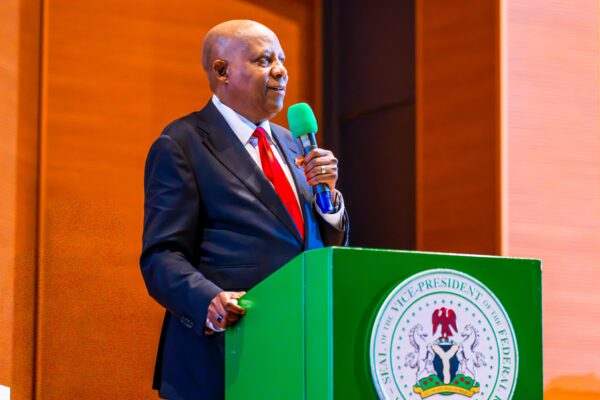
Tinubu spoke at the opening of the 8th EFCC/National Judicial Institute (NJI) Workshop for Judges and Justices in Abuja.
The President who spoke through Vice President Kashim Shettima, said the commission’s achievements reflected its determination to combat financial crimes, recover illicit assets and strengthen Nigeria’s international financial standing.
The workshop is themed “Investigation and Prosecution of Economic and Financial Crimes in a Digital Age.”
Tinubu disclosed that the EFCC filed 14,476 cases in court and secured 10,872 convictions during the first 34 months of the administration, representing a 75.1 per cent conviction-to-filing ratio.
He added that the commission recorded 1,370 convictions from 1,889 cases filed in the first half of 2026.
The President said the EFCC also recovered ₦1.233 trillion, $684.48 million, £373,905.78 and €9.34 million in monetary assets.
He particularly praised the commission’s efforts to tackle cryptocurrency fraud and recover virtual assets, describing them as evidence of its readiness to respond to evolving criminal methods.
“The EFCC’s recent momentum in tackling cryptocurrency fraud and its commendable strides in recovering virtual assets is highly reassuring,” he said.
Tinubu also cited the successful prosecution and subsequent deportation of 192 foreign nationals arrested for cyberterrorism and cryptocurrency fraud as evidence of the commission’s commitment to combating technology-driven crimes.
He noted that the increasing sophistication of financial crimes, fuelled by blockchain technology and artificial intelligence, required continuous capacity building for investigators, prosecutors and judicial officers.
The President pledged the Federal Government’s support for judicial capacity development, stressing that an independent and reform-minded judiciary was essential to the anti-corruption campaign.
He, however, urged the EFCC and the judiciary to strengthen prosecutorial discipline and address procedural loopholes that could frustrate corruption trials.
Tinubu maintained that the fight against corruption should not be treated as the responsibility of the Executive alone, but as a collective duty of all arms of government.
He also acknowledged the contribution of the EFCC’s asset recovery efforts to funding social intervention programmes, including the Nigerian Education Loan Fund (NELFUND) and the Nigerian Consumer Credit Corporation (CREDICORP).
In his welcome address, EFCC Chairman Ola Olukoyede said operational reforms had improved the commission’s capacity to secure recoveries and convictions.
He said the agency was strengthening intelligence-led investigations, forensic capabilities and domestic and international cooperation while improving its understanding of emerging financial technologies.
Olukoyede identified institutional bottlenecks, frivolous adjournments and frequent changes of legal representation as challenges that prolonged complex financial crime cases.
“When financial crime cases are allowed to drift indefinitely, the integrity of the process erodes. Evidence deteriorates and loses its cogency.
Witnesses disappear, relocate, or suffer memory lapses. Public confidence in the judicial system completely evaporates,” he said.
Olukoyede urged judges to ensure rigorous and expeditious adjudication of corruption cases while maintaining the integrity of judicial proceedings and the rule of law.
He said the objective was to build a more coordinated justice system in which investigators understood evidentiary requirements, prosecutors anticipated legal challenges, forensic specialists presented digital evidence effectively and judges understood the methods used to perpetrate and conceal financial crimes.
The Chief Justice of Nigeria, Justice Kudirat Kekere-Ekun, called for stronger judicial capacity to handle emerging financial crimes while upholding fair hearing, due process and judicial independence.
She noted that cryptocurrency transactions, encrypted communications, electronic records and cross-border financial activities had introduced new complexities into criminal proceedings.
According to her, judges must understand how digital evidence is obtained, preserved, authenticated and evaluated.
Kekere-Ekun stressed that the seriousness of an allegation must not determine the outcome of a trial, insisting that prosecutors must establish their cases through credible and legally admissible evidence.
She also urged judges to apply the Administration of Criminal Justice Act, 2015, effectively to prevent unnecessary delays without compromising the rights of parties.
The CJN highlighted Nigeria’s removal from the Financial Action Task Force’s grey list on October 24, 2025, as an important achievement that required sustained institutional commitment.
She cautioned, however, that cooperation among anti-corruption institutions must not extend to influencing judicial decisions.
Chairman of the Senate Committee on Anti-Corruption, Senator Emmanuel Udende, identified prolonged trials as a major obstacle to Nigeria’s anti-corruption efforts.
He said delays weakened deterrence, undermined public confidence, consumed judicial resources and complicated the recovery of public funds.
Udende urged judges to strengthen case management and minimise avoidable adjournments, while ensuring that defendants received fair hearings within a reasonable time.
Similarly, Chairman of the House Committee on Financial Crimes, Ginger Obinna Onwusibe, called for reforms to address gaps in the handling of digital evidence, the speed of trials and the legal framework for combating financial crimes.
Onwusibe pledged the National Assembly’s support for improved funding for forensic laboratories, digital investigation tools and specialised training.
He also promised legislative reforms to strengthen the admissibility of digital evidence and improve the management of virtual assets.
The lawmaker stressed that effective justice delivery required an adequately equipped and independent judiciary.
The Attorney-General of the Federation and Minister of Justice, Lateef Fagbemi, said successful prosecution of financial crimes depended on thorough investigations and the proper handling of digital evidence.
He urged investigators to ensure that evidence was lawfully obtained, carefully preserved and reliably authenticated before it was presented in court.
Fagbemi said prosecutorial success should not be measured solely by arrests or charges filed, but by the integrity of investigations, fairness of proceedings and sustainability of judicial outcomes.
Describing prosecutors as ministers of justice, he said their responsibility was to pursue justice lawfully rather than secure convictions at all costs.
He also emphasised the importance of recovering and managing proceeds of crime under the Proceeds of Crime (Recovery and Management) Act, 2022.
The minister called for stronger cooperation among the Ministry of Justice, EFCC, judiciary, financial intelligence institutions and other relevant agencies to tackle increasingly sophisticated and cross-border financial crimes.
The three-day workshop, attended by members of the Bench and Bar, anti-corruption experts and other stakeholders, is scheduled to end on Thursday, October 15, 2026.

