The Nigerian media should intensify scrutiny of the country’s ports and deploy investigative journalism to promote accountability, efficiency and economic growth.
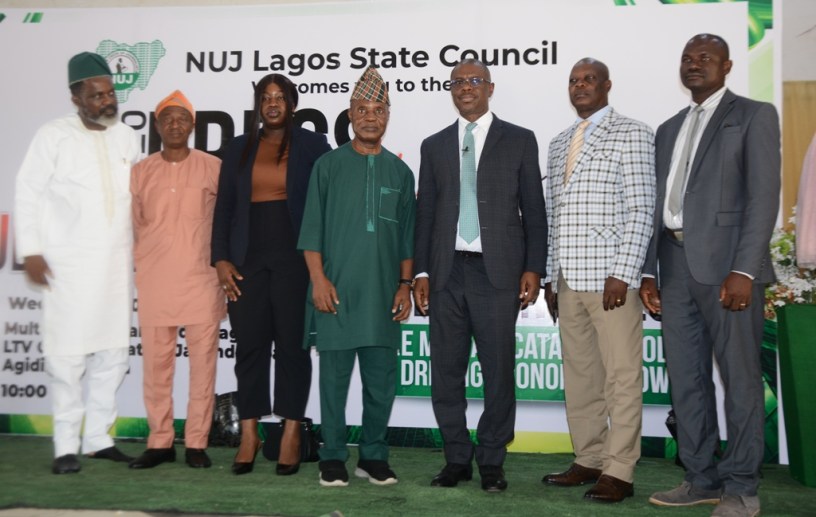
(L-R): Senior Lecturer, Nigerian Institute of Journalism, Dr. Jide Johnson; Senior Lecturer, Redeemers University, Dr. Demola Irinyemi; Senior Advocate of Nigeria, Jean Chiazor-Anishere represented Oluwatobiloba Bello; Chairman, NUJ Lagos State Council, Adeleye Ajayi; Guest Lecturer, Dr. Dakuku Peterside; Director, Public Affairs, Lagos State Ministry of Information and Strategy, Adesegun Ogundeji; and Chairman, Press Week Planning Committee, Adewale Akodu at the Public Lecture to mark the NUJ Lagos Council Press Week at the Radio Lagos/Eko FM Multipurpose Hall.
Former Director-General of the Nigerian Maritime Administration and Safety Agency, NIMASA, Dr Dakuku Peterside, made this known while delivering a keynote address at the 2026 Lagos State Council of the Nigeria Union of Journalists Press Week in Lagos, themed, Politics, Ports and Public Interest: The Media’s Catalytic Role in Driving Economic Growth in Nigeria.
Peterside, a management turnaround expert said Nigeria’s ports should no longer be regarded merely as gateways for cargo and revenue collection, but as critical economic infrastructure capable of driving industrialisation, boosting exports, attracting investment and creating jobs.
According to him, inefficiencies at the ports have direct consequences for Nigerians, contributing to higher prices of food, machinery and manufactured goods, while prolonged delays can undermine business confidence and discourage investment.
Peterside, a Lagos Leadership architect, said political governance plays a significant role in port performance through regulation, institutional leadership, infrastructure development and the coordination of agencies operating across the maritime sector.
He cautioned against attributing every port delay to government failure, noting that global shipping is also affected by geopolitical conflicts, adverse weather, port congestion and disruptions to international trade routes.
Peterside challenged journalists to distinguish between policy failures and external shocks, urging them to move beyond reporting official announcements and instead track measurable outcomes.
He called for sustained media attention to key port-performance indicators, including cargo dwell time, vessel turnaround, cargo-clearance periods, inspection delays, documented charges, export processing and concession performance.
Peterside also advocated the publication of quarterly port-performance scorecards and urged journalists to track government contracts, concessions, public expenditure and official commitments until their outcomes are established.
The Expert called for greater technical capacity among journalists covering the maritime sector, particularly in data journalism, maritime regulation, public procurement and international trade.
He noted that the reported 24.8 per cent increase in cargo throughput between 2024 and 2025 was significant but cautioned that increased cargo volumes alone should not be interpreted as evidence of broader economic prosperity.
The Lagos Leadership architect urged the media to focus increasingly on how efficiently Nigeria’s ports enable businesses to produce, trade, invest, and their contribution to job creation and wider economic development.

