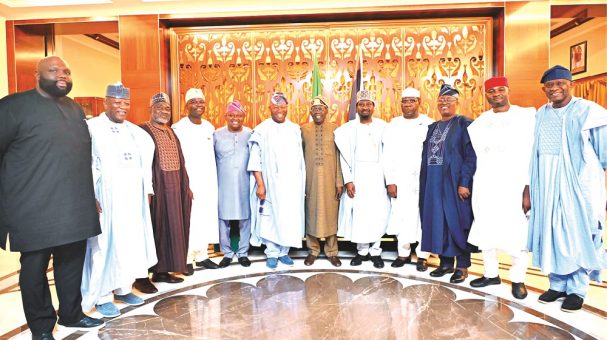
President Bola Ahmed Tinubu(seventh left) received in audience Senate leadership led by Senate President, Godawill Akpabio (sixth left); Deputy Senate President, Jubril Barau (fifth right); Senate Leader, Opeyemi Bamidele (fourth right); Solomon Adeola (fifth left); Abdul’aziz Yari (second left), Tokunbo Abiru (fourth left); Onyeyekachi Nwaebonyi (second right) and other senators during their Eid homage to the president in Lagos.
President Bola Tinubu has assured Nigerians that the country is gradually recovering from years of economic instability, declaring that his administration’s difficult reforms are beginning to yield visible results across critical sectors.
Tinubu in a nationwide address marking the third anniversary of his administration on 29th May, 2026, acknowledged the economic hardship experienced by citizens since the removal of fuel subsidies and the unification of the foreign exchange system, but insisted the sacrifices made by Nigerians were necessary to prevent a deeper national crisis.
According to the President, Nigeria inherited severe fiscal and structural challenges in 2023, including unsustainable fuel subsidy payments, mounting debt pressures, exchange-rate distortions, insecurity, declining public confidence, and weakening infrastructure.
Tinubu revealed that Nigeria previously spent as much as ₦18.4 billion daily on petrol subsidies, amounting to over ₦4 trillion in 2022 alone, while multiple exchange-rate windows allegedly enabled forex speculation and economic leakages estimated at more than ₦8 trillion within three years.
The situation demanded urgent and courageous action. Difficult but necessary decisions had to be taken to stabilise the economy and prevent a deeper national crisis,” the President stated.
Despite admitting that the reforms triggered a sharp rise in living costs and placed pressure on households and businesses, Tinubu said the country has now begun witnessing signs of recovery and renewed investor confidence.
He pointed to the performance of the Nigerian stock market as evidence of economic improvement, noting that market capitalisation rose from ₦30 trillion in 2023 to ₦160 trillion in 2026.
The President also highlighted ongoing infrastructure development projects across the country, including the Lagos-Calabar Coastal Highway, Sokoto-Badagry Super Highway, Abuja-Kaduna-Zaria-Kano Road, East-West Road, and several rural road projects.
According to him, over 2,700 kilometres of highways and major roads are currently under construction, reconstruction, or rehabilitation nationwide.
On the energy sector, Tinubu disclosed that reforms in oil and gas had attracted fresh international investments, while projects such as the $5 billion NLNG Train 7 initiative are nearing completion.
He added that increased local refining capacity and modular refinery operations are helping Nigeria reduce dependence on imported petroleum products and conserve foreign exchange.
The President said his administration is also confronting long-standing power sector challenges by expanding transmission infrastructure, investing in renewable energy, strengthening the national grid, and clearing legacy obligations.
“No modern economy can grow in darkness,” Tinubu said, while reaffirming his administration’s commitment to industrial growth and stable electricity supply.
Addressing social interventions, Tinubu stated that agricultural programmes have supported millions of farmers through improved seedlings, fertilisers, irrigation, mechanisation, and expanded access to financing and markets.
He further disclosed that the Nigerian Education Loan Fund has provided access to higher education for over 1.5 million students, with more than ₦282 billion already disbursed.
The President also highlighted the Renewed Hope Housing Programme and Federal Housing Authority projects, which he said are delivering over 10,000 housing units across 14 states and the Federal Capital Territory while generating more than 300,000 jobs.
In the telecommunications sector, Tinubu noted that government interventions have helped restore investor confidence, expand digital infrastructure, and increase nationwide connectivity.
Speaking directly to Nigerian youths, the President described them as “the engine of Nigeria’s future,” stressing that the government is investing in digital skills, innovation, enterprise support, technical education, and job creation initiatives.
On security, Tinubu said security agencies have intensified operations against terrorists, kidnappers, bandits, oil thieves, and other criminal networks across the country.
While admitting that security challenges persist, he maintained that several communities and major highways are becoming safer and more economically active.
The President called on Nigerians to remain hopeful and united, urging citizens to reject division and work collectively toward national development.
“We chose reform over ruin and long-term recovery over temporary comfort,” Tinubu declared.
He added that although Nigeria has not yet solved all its challenges, the foundation for economic recovery and long-term prosperity has been laid.
Tinubu concluded the address by expressing confidence in Nigeria’s future, insisting that the country would emerge stronger, more united, and more prosperous despite current difficulties.
 securityandsafetymatters