
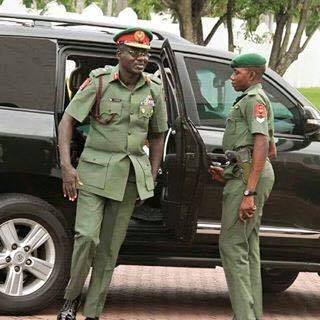
Security challenges facing Nigeria have made the development of middle cadre officers on the rudiments of logistics crucial.
Chief of the Army Staff, Lieutenant General Tukur Buratai, said in the past decade, Nigerian Army operations had witnessed dramatic changes from conventional to asymmetric warfare.
Buratai noted this necessitated the development of competent logisticians to meet the reality on ground, saying one of the ways to meet the reality was to train officers on modern concepts and techniques in the field of logistics.
He spoke at the Logistics Staff Course graduation ceremony of the Nigerian Army College of Logistics in Lagos where he was special guest of honour.
This underscores the importance of Nigerian Army College of Logistics to the Nigerian Army,” he said advising, “mischief makers and criminals to shun violence and all forms of criminality as offenders will surely be made to face the full wrath of the law.”
He appreciated the coverage and cooperation the Army enjoyed from the media and promised to continue “to require your cooperation in its effort to protect critical national assets in the Niger Delta from the wanton activities of the Niger Delta Avengers.”
Buratai thanked President Muhammadu Buhari for his commitment and encouragement towards combating security challenges facing the nation promising: “On our part, our response to his excellency kind gesture is our unalloyed loyalty and subordination to the democratic governance.”
Commandant of NACOC, Major General Joseph A Orokpo, told his guests: “Today’s graduation ceremony formally marks the successful completion of yet another Logistics Staff Course.
The course assembled on 8 January 2016 and is made up of 20 students comprising 19 Nigerian Army officers and one Nigerian Navy officer.
It has been 31 weeks of intense training and academic activities for these students.
The course is designed to train middle cadre officers and supporting staff in the preparation and execution of logistics plan in support of formations up to corps level.
This is done by developing their understanding and application of modern strategic management concepts appropriate to defence logistics, improving their professional skill in the acquisition of military hardware as well as planning and providing efficient logistics support for the NA and Peace Support Operations.”

